In the summer of 2026, the world’s attention is focused almost entirely on one thing: the World Cup, expanded to 48 teams for the first time in history and cohosted by the United States, Canada, and Mexico, is moving steadily toward the final. But to another group of people, those same ninety minutes are more than just a match.
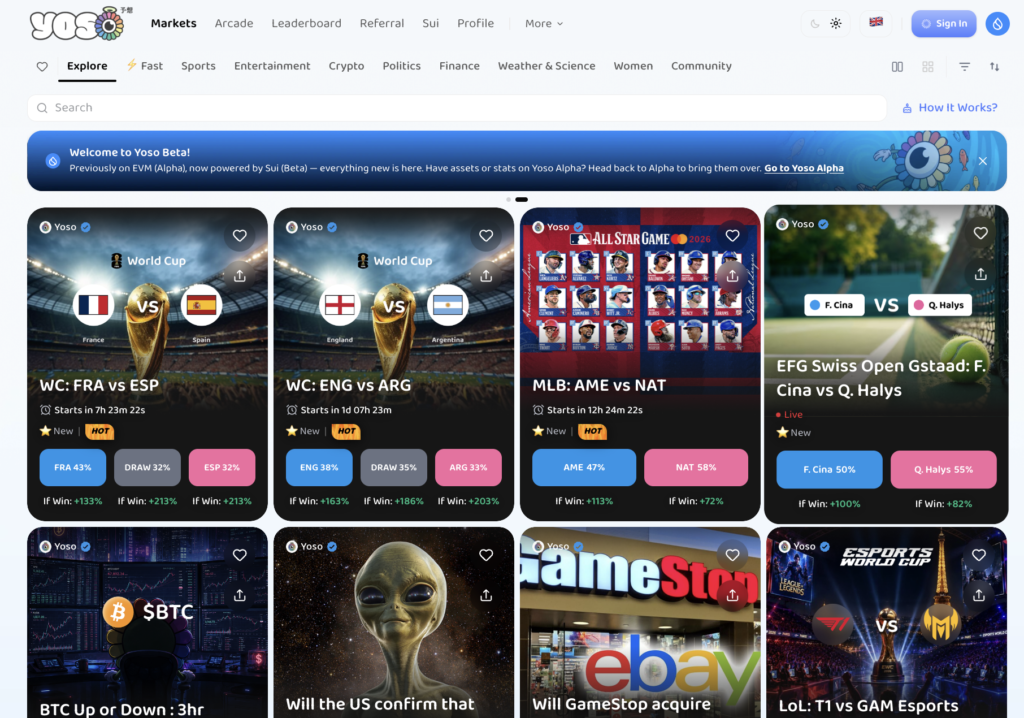
“Which team will lift the championship trophy?” That single question has drawn in an astonishing amount of capital. Every knockout match, and every critical moment, has become a market that can be traded in real time, with each game broken down into contracts that move with the state of play.
This is what a prediction market is: it turns future events that have not yet happened into tradable contracts. Over the past two years, prediction markets have grown from a niche experiment in the crypto world into one of the few areas of finance that is still accelerating. Yoso, built by James Shen and his team, is one of the new players in this space.
What is a “Prediction Market”?
Will the Federal Reserve raise interest rates at its next meeting? Will evidence of extraterrestrial life emerge this year? Will Taylor Swift get engaged before the end of the year?
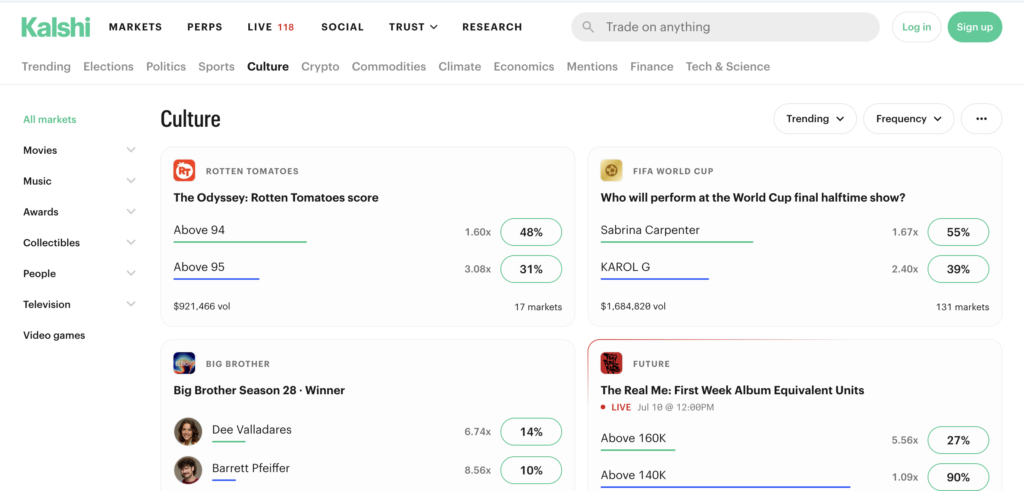
These seemingly unrelated questions are all turned into propositions that people can trade with money on “prediction market” platforms such as Kalshi and Polymarket, where you can bet on whether events will or will not happen. If you believe that an event will happen, you buy in; if it comes true, the contract is redeemed at full value. If you are wrong, it’s worthless. As long as there is someone willing to buy your position, you can sell and exit at any time. Thus, for the first time, the “probability of an event” has a price that changes in real time. The more people bet on a certain outcome, the higher the price becomes. This is why, during elections, prediction market prices are regarded by financial media as a more sensitive indicator than opinion polls.
At this point, most people’s first reaction is probably: Isn’t this just sports betting? In fact, the key difference lies in “who you are betting against.” When you buy lottery tickets, you are betting against the bookmaker, who is on the opposite side of the trade; if you win, they lose. But the prediction market is more like an exchange, in which your contract is traded with “someone who holds the opposite view.” The platform itself does not participate; it earns revenue from trading volume.
Because it resembles an exchange, the price can fluctuate at any time, and positions can be sold at any time, without having to wait for the end of the session or for the final vote count. This status is also reflected in regulation. In the United States, these contracts have an official name, “event contracts.” They are treated as a type of financial derivative and regulated by the Commodity Futures Trading Commission (CFTC) rather than by state gambling laws.
The 2024 US Presidential Election Lit the Fuse, and Other Categories Followed
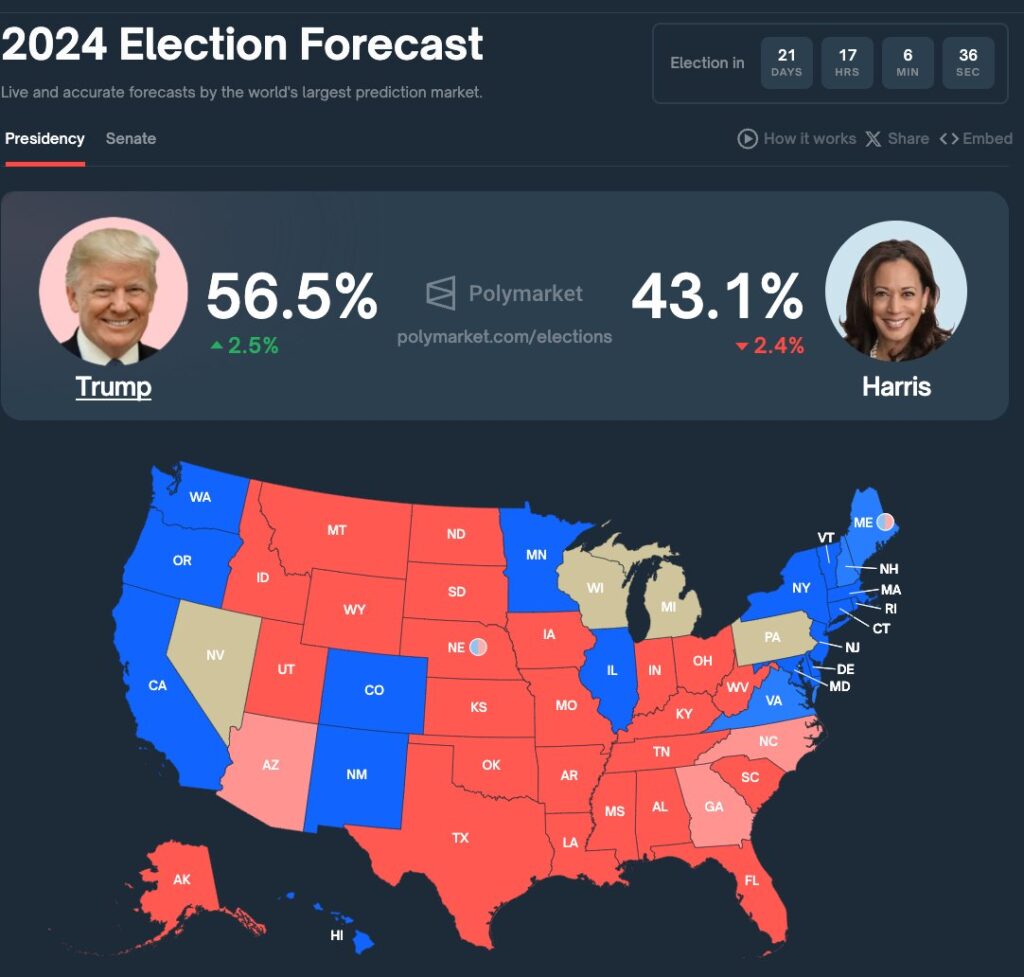
Once the regulatory green light appeared, traffic poured in. During the 2024 US presidential election, the single market asking “Who will be elected president?” generated over US$3.6 billion in trade volume for Polymarket. The market was initially worried that interest would cool down after the election, but the enthusiasm quickly found new outlets. Sports supported Kalshi, while politics and crypto were Polymarket’s main focus. In addition, there was a constant stream of topics such as the Fed’s interest rate hikes, corporate earnings, the weather, Netflix rankings, and celebrity activities, as there was always another event to predict.
By 2025, Polymarket and Kalshi had become the two giants of this space. The former started with blockchain and uses stablecoins for settlement, while the latter is a regulated exchange licensed by the US CFTC. Market capital has also made heavy bets. Intercontinental Exchange (ICE), the parent company of the New York Stock Exchange, has invested a total of US$2 billion in Polymarket, while Kalshi completed a new funding round at a valuation of approximately US$22 billion.
Not Building the Next Polymarket! Yoso Enters a Market the Giants Have Overlooked
But however large the two giants may be, they cannot cover every topic. When everyone was asking, “Besides these two, who else has a chance?” James Shen’s answer was a completely different map.
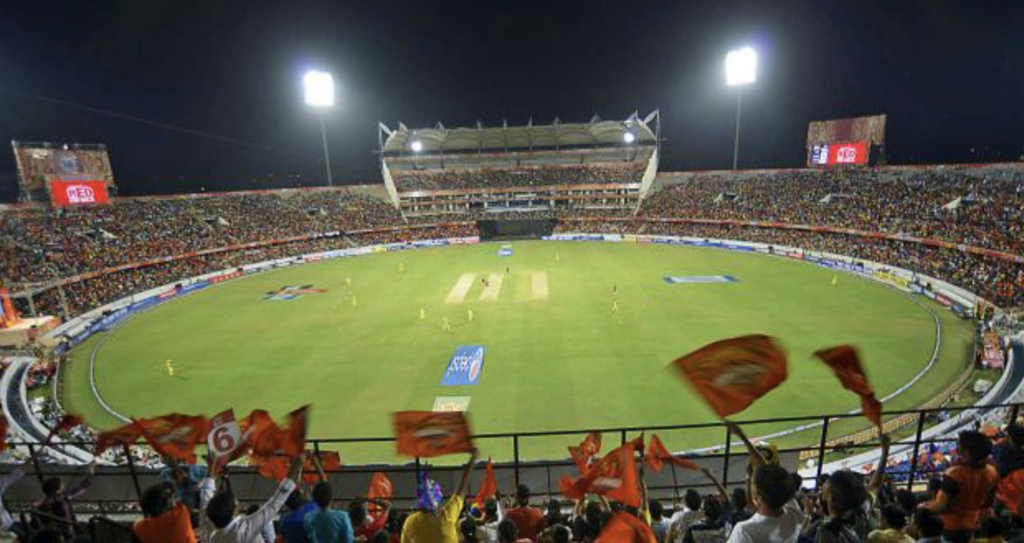
The focus of this map is not US elections, nor is it the NFL or the NBA. These worldwide trending topics are also available on Yoso’s platform, but only as side dishes. The real home field for James and the Yoso team is an area the two giants have barely taken seriously: cricket.
The move into cricket was not a spur-of-the-moment idea, but the result of a series of deductions. “We believe that beyond Polymarket and Kalshi, unmet demand must still exist,” James said. “And that demand is for things that local people care about, not for global events.”
Following this line of thought, several things came together. First, cricket is the third most popular sport in the world, behind only football and basketball in terms of audience size and commercial value. The Indian Professional League (IPL) is the world’s largest cricket tournament, with hundreds of millions of people in one country obsessed with it. Second, Indians are as enthusiastic about prediction as anyone else. Of course, the two giants also list major events such as the IPL, but their focus has always been on American sports and politics. This overlooked demand is where the opportunity lies.
So, the Yoso team first released a batch of questions to test the waters. What truly surprised James was that demand began to grow on its own. Cricket is a common language across the Commonwealth, and once the questions went live, users from Australia, New Zealand, South Africa, Bangladesh, and Pakistan emerged one after another.
Cricket is just the entry point. From there, Yoso has developed an entire localized question bank, including kabaddi, a local Indian sport, followed by India’s version of real world assets. Tradable topics include local blue-chip stocks, the NSE Nifty (known as the “Indian S&P 500”), and oil prices. On top of that, Yoso adds another layer of culture and traffic-driven topics, including weather forecasts and celebrities’ posts and activity on social media.
What truly makes this strategy work are the two engines hidden beneath the question bank.
The first engine is an AI deep learning system. The most labor-intensive part of prediction markets is not just matching trades, but also determining “what questions to ask.” When a major event occurs, someone needs to break it down into a clearly defined question that can be objectively settled. Yoso entrusted this task to a group of AIs. One group of bots monitors competitors’ posts, sports events, and local media around the clock, suggesting which topics to create at the first sign of movement and capturing traffic before the two giants do. The other group is responsible for translating users’ imaginative “wishes” into clearly defined questions that can be settled. Finally, additional AI agents help automate market making and trade monitoring in order to meet traders’ needs. For a platform that seeks to win through being “local and real time,” this effectively turns reaction speed into a moat.
The second engine is a financial mechanism designed by James. When new users enter the platform, they receive an amount they can trade with directly, and they can only withdraw the portion they have earned after meeting certain conditions. The result is straightforward: the cost of acquiring a new user has been reduced to almost negligible levels, which is the foundation that allows Yoso to grow rapidly despite competition from the giants.
The results speak for themselves. The product, which was officially launched in February this year, has achieved an annualized trading volume of over US$100 million in just a few months with almost no marketing costs. It records about US$2 million in weekly trading volume and has accumulated around 50,000 registered addresses.
Lessons Learned from Multiple Startup Journeys
James Shen studied mechanical engineering in college, but what truly fascinated him was mathematics, psychology, and philosophy. “I am a person who is curious about many things, so I always want to search for the underlying logic of things,” James said. This curiosity led him into the world of blockchain. He is a serial entrepreneur, an active angel investor, and one of Binance’s earliest investors. Along the way, he has accumulated several judgments that have been tested repeatedly.
The first is about timing. When he was developing B2B products in the past, he believed that features had to be complete and fully polished before launch. When he shifted to Yoso, which targets the mass market, he completely overturned that approach. For a product that is racing against time in a competitive market, “timing” is the key to success.
The second is about users. He discovered that what developers think is important is often different from what users actually care about. The team once spent great effort making every number in the database precise and accurate, but users did not notice at all. What truly keeps users engaged are things that seem minor but directly affect the experience, such as whether deposits are smooth and whether order execution deviates from the price users see.
The third is about “doing what others are not doing.” He does not compete with the giants over who has the lowest fees. “When you have something that others do not, you get to set the price.” That is why he started with cricket and localized topics. Rather than cutting prices in a competitive market, it is better to differentiate yourself from others.
All of these judgments ultimately point to the same greater conviction. In James’s view, prediction markets will not be just a passing trend. The human desire to place bets will not disappear, and regulations in different countries will eventually catch up and define this market clearly. As the market matures, this place that turns the “future” into an asset will grow from a niche activity into a legitimate part of the financial world.