Graduation season is a time when students look to the future. The bachelor’s cap is thrown into the air, signifying that a new stage of life is about to begin. But when the cap falls, many realize that upon leaving campus, they are not facing the bright future they imagined, but a cold reality.
College graduates around the world are experiencing one of the toughest employment environments in recent years. In the United States, the unemployment rate for graduates in computer engineering–related fields has reached 7.5%—nearly twice the national average for all fields. The Financial Times reports that even for graduates of top-tier institutions such as Harvard Business School and the MIT Sloan School of Management, the proportion of graduates still seeking employment three months after graduation has risen significantly since 2021.
Why is this happening?
One of the main reasons is that AI is rewriting the barriers to entry for many careers.
For a long time, there has been a relatively stable pathway between education and the workplace: one could graduate, find an entry-level position, learn on the job, and gradually gain experience, allowing an employee to move up the ladder. However, the advent of AI is effectively removing this ladder that leads from school to the professional world.
According to the Stanford Digital Economy Lab, employment rates for 22- to 25-year-olds have declined significantly in the industries most affected by AI. This trend is led by entry-level jobs such as software development, customer service, and clerical work—jobs that used to be filled by new graduates.
With the emergence of AI, enterprises automate entry-level tasks, eliminating the need for a company to spend time and resources gradually cultivating talent. The impact on the younger generation is far reaching and comprehensive: when the entry point to an industry disappears, “novices” no longer have the opportunity to become “veterans,” and a massive fault line in the workplace begins to surface.
“We received 2,000 résumés, yet we couldn’t find anyone we could use.”
John Yue, founder and CEO of Silicon Valley startup Inference.ai, feels this disconnect firsthand.
He shared that his team once posted a job opening for an engineering position and received more than 2,000 résumés in a short period of time, including many from graduates of Ivy League schools. “But in the end, none of the candidates really fit what we were looking for,” he said.
In Yue’s view, the problem stems from a structural issue that has been rapidly amplified by AI: enterprises have shifted their expectations of talent to “immediate operation capability,” but the education system is still stuck in the rhythms of the past, lacking a real-world environment that is synchronized with the industry.
Yue cited AI- and machine learning–related positions as an example. Talent with hands-on GPU experience is currently one of the most pressing needs for companies, but GPUs remain an extremely scarce resource in most university programs. Even when students have mastered basic theories, they lack the opportunity to train models in a real-world environment or understand actual industry needs, further widening the gap.
The Other Neglected Market: AI’s “Mirror World”
While most companies are focusing on how to use AI to reduce costs, increase efficiency, and replace human labor, John Yue sees another overlooked market that is expanding simultaneously.
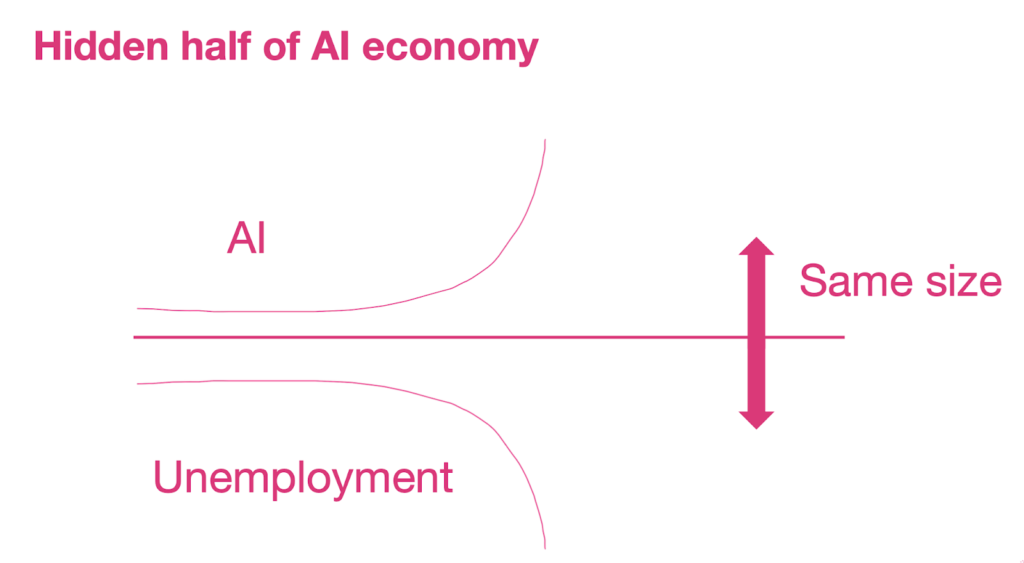
“AI has brought about not just a revolution in efficiency, but two markets of comparable size that are growing at the same time,” John explains. He picks up a pen and paper, drawing one upward and one downward curve. “One line represents the ‘efficiency market,’ where companies adopt AI to save on labor costs, and the other is the ‘human market,’ consisting of workers replaced by automation who need to reenter the workforce.”
In his eyes, these two curves are like reflections in a mirror: for every dollar of labor cost saved by AI, a corresponding dollar of demand for “reemployment” is created on the other side of society.
Inference.ai was born out of this “mirror market.”
A “Trillion-Dollar” Employment Infrastructure for the AI Era
The World Economic Forum predicts that over the next five years, about 83 million jobs will disappear globally as a result of automation and AI, and that about half of the workforce will have to be retrained to remain employable. For John Yue, this represents a trillion-dollar market in the making. “What we’re trying to do is rebuild a pathway back to the workplace for those who have been displaced by AI.”
Yue further explained that Inference.ai is building an “employment infrastructure” for the AI era, designed to help those displaced by AI to once again become valued contributors to society and return to the workforce.
Inference.ai initially focuses on the most understaffed jobs in AI and machine learning—high-profile positions that require hands-on experience but have long lacked a clear, scalable path for training and employment. Inference.ai then divides its solution into three core components: First, Inference.ai utilizes AI to continuously analyze real-time job openings and hiring data from around the world to identify persistent market gaps that are difficult to fill.
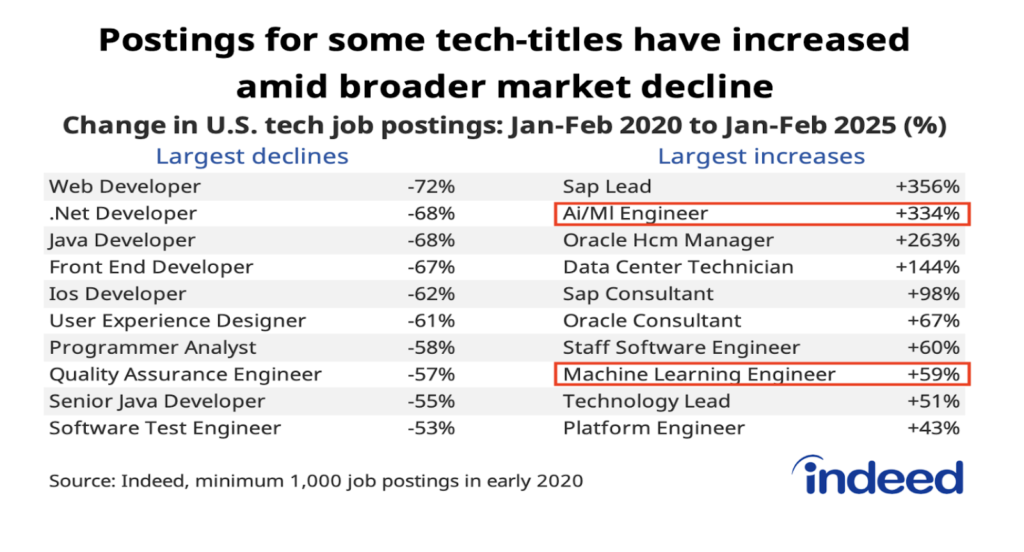
The system then aggregates and analyzes a vast number of job descriptions, using AI to precisely break them down into a structured skill tree. For example, when analyzing a high-level position such as “Machine Learning Engineer,” AI parses the core competencies and practical abilities required, layer by layer. This includes Python-based programming proficiency, a deep understanding of model training and inference workflows, the practical application of mainstream deep learning frameworks like PyTorch, and CUDA and GPU-accelerated computing capabilities. Furthermore, AI clearly defines the depth of knowledge and practical standards required for each skill level.
Next, trainees enter a highly personalized training and practice phase. Inference.ai’s learning experience is different from traditional courses, consisting of dynamic, AI-driven content rather than a one-way, static textbook. An “AI Instructor” is responsible for course lectures and real-time Q&A, while an “AI Facilitator” guides students through hands-on practice, helping them to operate models in authentic development and training environments. Trainees use partitioned NVIDIA GPUs to carry out training and inference for machine learning and deep learning models.
In addition to AI-led practice, Inference.ai also partners with real-life industry mentors from top-tier US tech giants. The entire process is centered on the principle of “learning by doing,” ensuring that participants acquire industry-standard, real-world capabilities immediately upon completing their training.
Finally, Inference.ai utilizes an “AI Interviewer“—equipped with a question bank reflecting the latest industry standards—to help students repeatedly validate their skills in real-world scenarios. This allows trainees to confirm whether they have mastered actual machine-learning skills after training. For enterprises, the AI Interviewer can pre-screen qualified candidates from a massive talent pool, significantly reducing the time spent scouting for talent.
John Yue recently came to the University of California, Santa Cruz, to share his perspective on the industry. He said, “When recruiting, companies are more interested in what problems you can solve than in your potential.” (Image source: Inference.ai Academy)
Where do Inference.ai’s key advantages come from?
This seemingly simple business model is not easily replicated; it is deeply rooted in Inference.ai’s proprietary technology.
At the core of Inference.ai’s capabilities lies a “fractionalized GPU“ infrastructure. Simply put, high-performance NVIDIA GPUs are broken down into small, affordable units without sacrificing performance. This way, trainees are able to access authentic industry-standard model training and inference environments at an incredibly low threshold, moving beyond mere simulations or theoretical learning. This is precisely the hurdle that most education and training platforms have long been unable to clear due to cost and technological barriers.
Because computational power is no longer a bottleneck, Inference.ai can rapidly scale its AI-driven training and skill validation processes, effectively helping workers gain entry into major US tech companies.
Due to these proven results, Inference.ai’s solutions have naturally spread within the US engineering community without any paid marketing. Inference.ai is also partnering with several North American universities and training organizations to help students and workers quickly connect to the workplace in the AI era. Currently, the Inference.ai community already has over 1,000 members who have completed four levels of training, and that number continues to grow rapidly.
As trainees complete their training and reenter the workplace, they return to the community as mentors, bringing in new members and gradually forming a self-sustaining, ever-expanding “growth flywheel.” On the commercial side, Inference.ai has achieved profitability with average gross margins exceeding 90%, providing a strong economic foundation for its “employment infrastructure” model.
When AI goes from “tool“ to “competitor“
When it comes to whether AI is replacing humans, John Yue offers a humorous comparison, stating: “AI is more like an alien species.” He believes that AI is fundamentally different from previous technological leaps. “In the past, whether it was the Industrial Revolution or the computer revolution, the essence was about making humans more efficient. Each development served an ‘auxiliary’ role. However, when generative AI begins to take over thinking, writing, and decision making, the role of technology changes from ‘assistance’ to ‘competition.’ I think this AI revolution is more like an alien invasion: they aren’t here to help; they’re here to compete with humans for their livelihoods!”
That’s why Inference.ai has chosen a different path. When the world’s most powerful computational resources are being used to automate human jobs, Inference.ai uses that same power to make humans needed again, creating new possibilities for growth.
AI is disrupting traditional employment models, but for John Yue, what really matters is paving a way back into the workplace for those who have been displaced.