On May 28, 2025, 127 remixes of the same song were released across major streaming platforms on the same day, breaking a Guinness World Record.
The song was “come again”, released in 2001 by Japanese hip-hop group m-flo. It brought the 2-step sound that was sweeping the UK at the time into Japan’s pop scene and became one of the defining J-pop anthems of the early 2000s. Then, like so many hits before it, the song gradually faded into karaoke catalogs and nostalgia playlists as the years went by.
That changed in 2024, when m-flo performed the song with Sho Sakurai on the annual music special Best Artist 2024. The following year, a dance practice video by girl group IS:SUE reignited interest in the track, pushing the original “come again” music video past 50 million views. A 24-year-old “old” song had found a new generation of listeners who had not even been born when it was released.
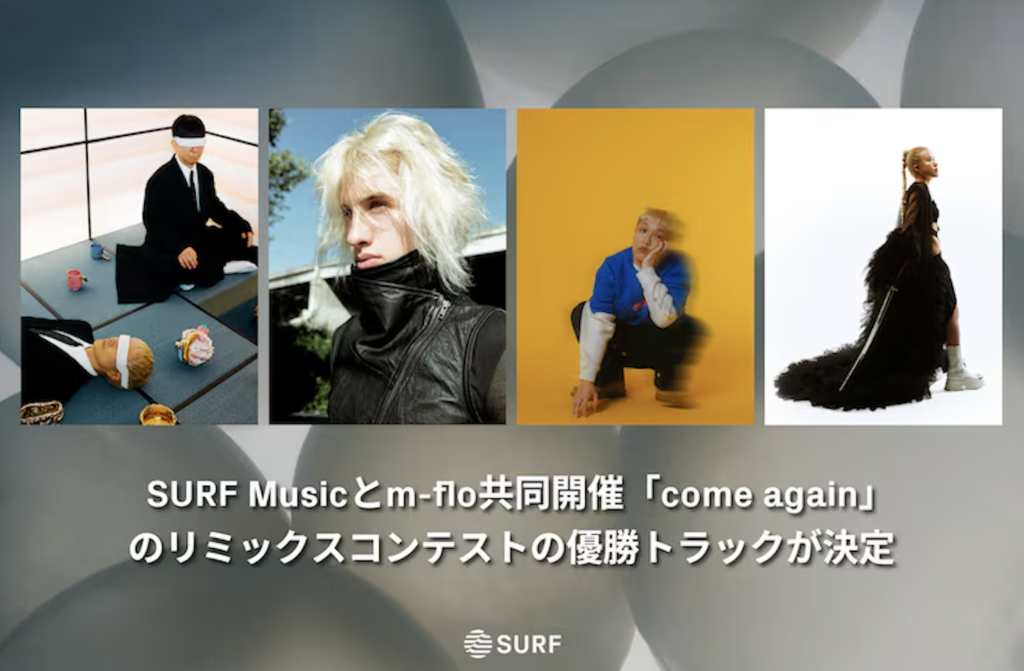
The release of those 127 remixes marked the culmination of the song’s remarkable comeback. The competition was jointly organized by m-flo and a Japanese startup founded less than five years earlier: SURF Music.
150 Unreleased Songs Gave Rise to SURF Music150 Unheard Songs Gave Rise to SURF Music
SURF Music is a digital marketplace founded by veteran Japanese musician Ken Kobori that focuses primarily on unreleased music. Creators upload tracks that have yet to find a home, while record labels, A&R teams (the departments responsible for discovering artists and selecting songs), and film and television production companies use SURF Music to scout promising material.
Kobori has spent more than 20 years in Japan’s music industry. He is best known for “Story,” a 2005 song performed by singer AI. The song remained in the top 10 of the Oricon chart for 73 consecutive weeks. Nine years later, Disney chose it as the ending theme for the Japanese version of Big Hero 6, cementing its status as a classic familiar to audiences across Japan.
But being able to write a song like that does not mean you know how to market yourself. After his long-term management contract with Dentsu ended, Kobori went independent. “For a while, I didn’t know how to meet new artists or people at record labels, and I’m really bad at promoting myself,” Kobori admitted. “I felt a little lost.”
To solve the problem, he built a simple website, uploaded around 150 of his unreleased songs, and gave several record labels and management companies access to them. Three months later, three of those songs were picked up—and all three had been written 15 to 18 years earlier.
“Those songs sounded terrible to me. There’s no way I would let anyone hear them now,” Kobori said with a laugh. “But then I thought, if I have more than a hundred songs sitting around, producers all over the world must have tons of tracks gathering dust on their hard drives. If there were a platform where everyone could upload their music and record labels could choose from that catalog, it could help creators all over the world.”
The website he built for himself eventually grew into a company. SURF Music officially launched in 2023 and now has more than 40,000 creators from 195 countries and over 450 B2B clients. Major Japanese record labels have joined the platform, while music discovered through SURF has been featured in projects by Pokémon and Disney. SURF Music has also helped nine songs reach the top five on charts in Japan and South Korea.

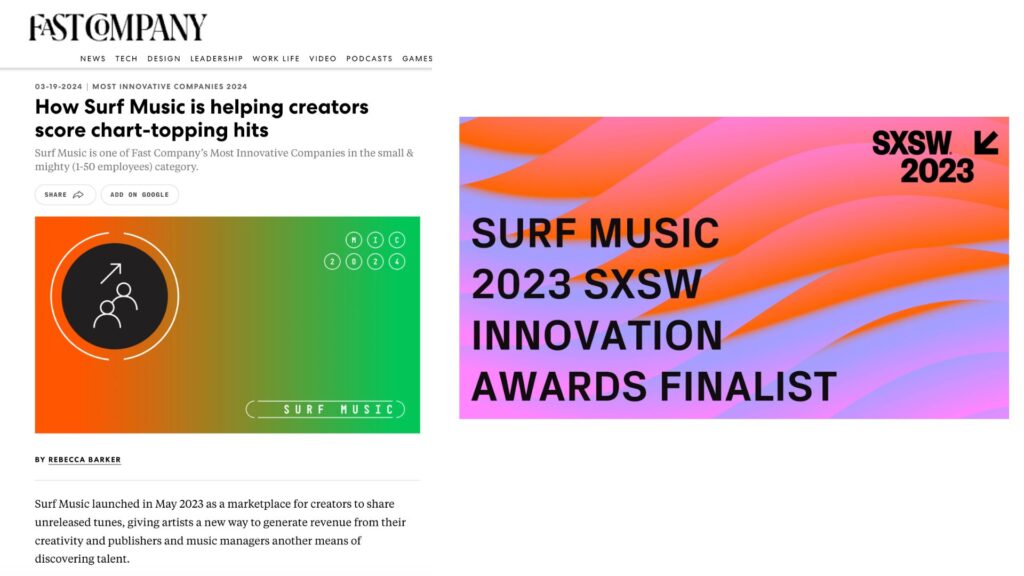
In 2023, SURF Music was named a finalist for the SXSW Innovation Awards, and in 2024, it was recognized by Fast Company as one of the world’s most innovative companies. In the first half of this year, the company also completed a $7.9 million pre-Series A funding round.
Apart from Cherubic Ventures, nearly all of its new investors are major players in the music industry. They include YG Plus, a subsidiary of South Korean entertainment giant YG Entertainment; leading Japanese music production company agehasprings; and companies such as Enigmo, Rainbow Entertainment, and Hip Land Music.
Before SURF, Who Heard Your Music Depended on Who You Knew
To understand the value of SURF Music, you first have to look at what it is trying to replace.
In Japan’s music industry, Kobori explained, finding a great song often starts with an email list. Every A&R executive at a record label has their own private “email list,” a network of contacts built up over the years. When an artist needs new material, the A&R executive sends a brief to everyone on that list, then listens to the submissions one by one and selects the most suitable tracks. A call for songs for a major artist can attract hundreds of submissions at a time.
“Even if you listen to only 15 seconds of each song, getting through them all is still grueling,” Kobori said he spent about a year working in A&R at Universal Music, and that entire year was spent listening to demo after demo.
And this system creates two problems at once: veteran A&R executives have inboxes constantly flooded with demos, many of which do not match what they are looking for, while junior A&R executives without industry connections have no list at all and must rely on senior colleagues for introductions, slowly building their networks one contact at a time.
That email list is exactly what SURF Music aims to replace. New creators from around the world contribute music to SURF’s catalog every day. This means junior A&R executives no longer have to wait for senior colleagues to make introductions, and record labels in Tokyo no longer need intermediaries to connect with producers in Los Angeles or Seoul.
Using AI to Solve the Search Problem
But as the catalog grows, another problem emerges: with tens of thousands of tracks to choose from, how do you find the one that fits best? Kobori explained, “Once users log in, they can use SURF Music’s AI search to find a specific kind of track. They can simply type in a sentence like ‘a lonely girl has just broken up with her boyfriend and is walking home alone,’ and the system will find songs that sound exactly like that.”
Three songs for Disney+ productions have been selected this way: a director simply copied and pasted the script for a scene that needed music and had SURF Music recommend suitable tracks.

Building a “Google Workspace” for Cross-Border Music Collaboration
Kobori himself is one of the most active creators on the platform.SURF Music analyzes the work uploaded by each creator and connects people around the world who make similar kinds of music. That is how Kobori found the collaborators he works with today.
“Actually, I really enjoy working with Korean music creators, but before this, it simply wasn’t possible,” Kobori said. “We didn’t speak the same language, so we needed an interpreter.”
That challenge led to the creation of SURF Sessions. Creators can start a session and bring together collaborators for arranging, songwriting, and other roles. Everyone in the chat chooses their preferred language, so Kobori can type in English while a producer in Seoul instantly sees the messages in Korean. All the files are also kept together in a cloud drive dedicated to that song. “We used to send project updates back and forth by email,” Kobori said. “So we were constantly asking, ‘Where did that folder go?’ Now everything is centralized, and everyone knows exactly where the project stands.”

“They Said I Was Living in La-La Land”
These features may seem like obvious ideas today, but when Kobori first took the concept to friends in the industry, they all gave him the same answer: it would never work. Everyone who said so worked in the music industry. It was precisely because they understood how the business operated that they were so certain.
“But I’ve been like this since I was a kid,” Kobori said. “When someone tells me something can’t be done, it only makes me want to do it more.”
Their skepticism came down to two questions. First, why would top creators trust an unfamiliar platform with their unreleased music? Creators are fiercely protective of their work. As Kobori put it, “A song you create is like your child.” Second, why would record labels pay to use the platform? They could already get songs from the best producers.
The first issue was the classic chicken-and-egg problem faced by every two-sided marketplace: without a strong catalog, record labels would not come; without record labels, creators would not upload their work. SURF Music chose to build up the supply side first, and Kobori took the most hands-on approach possible: reaching out to creators one by one. Drawing on the network he had built over the years, he contacted producers individually. “I probably had close to a thousand Zoom meetings with different producers,” he said. Eventually, he persuaded them to upload their unreleased work.
After the platform attracted around 1,000 creators—including Grammy winners and producers behind Billboard No. 1 hits—Kobori no longer had to persuade every new creator personally. As the catalog expanded and record labels began signing on, creators’ attitudes shifted: if those companies were using SURF, the platform had to be legitimate.
Giving Up Commissions Earned Industry Trust
The second issue nearly backed the company into a corner and taught Kobori an important lesson: in a mature industry, how others categorize you can sometimes matter more than what you actually do.
SURF Music’s original business model seemed perfectly reasonable: take a 10% cut of royalties when a song was selected, a standard approach for many marketplaces. But in Japan’s music industry, that commission sent a clear signal. “The record labels said, ‘If you take a cut of royalties and match songs with opportunities, then you’re a publisher—you just don’t call yourselves one.’”
In Japan, a music publisher signs creators, places their songs with artists or labels, and takes a share of the royalties in return. Once SURF Music was categorized as a publisher, it was no longer seen as a neutral tool, but as another party taking a cut from the royalty chain. Record labels would have to pay an additional share, while top creators who already had publishers would see yet another slice taken from their royalties.
Kobori therefore scrapped the original business model and switched to a pure subscription model. Once the positioning changed, so did the record labels’ attitudes—and doors began opening one after another. “In the end, they saw the value we were bringing and got behind our mission.”
One of the people who had initially told him it was impossible was working at Sony at the time. Four years later, Kobori showed him what he had built. His response was: “Oh my God, you actually did it.” Today, that person works at SURF Music too.
Bringing Everyone Who Makes Music Together on SURF
Looking further ahead, Kobori’s vision for the next five years goes far beyond a “music marketplace.” He wants everyone in the industry who works with music to have a SURF account, with the platform connecting them to one another. “That’s our core goal: to connect everyone so people can create great music together.”
What makes it all worthwhile for him is watching creators on the platform go from relative obscurity to landing opportunities to work with major artists, with many of them now even launching companies of their own. “Watching them grow like that is the most rewarding part for me.”
In the end, the platform Kobori originally built for himself really did solve his own problem. Now 46, he sets aside just one day a week for music. On that day, he comes up with five song ideas, then hands them off to more than a dozen producers he regularly collaborates with through the platform to develop into finished songs. At his most productive, he has completed as many as eight songs in a single week.
“I’m probably making more music now than I ever did before,” he said.